Table of Contents
ToggleGoogle Gemini 2.0 vs ChatGPT 5: A Clean, Fact-Based Comparison
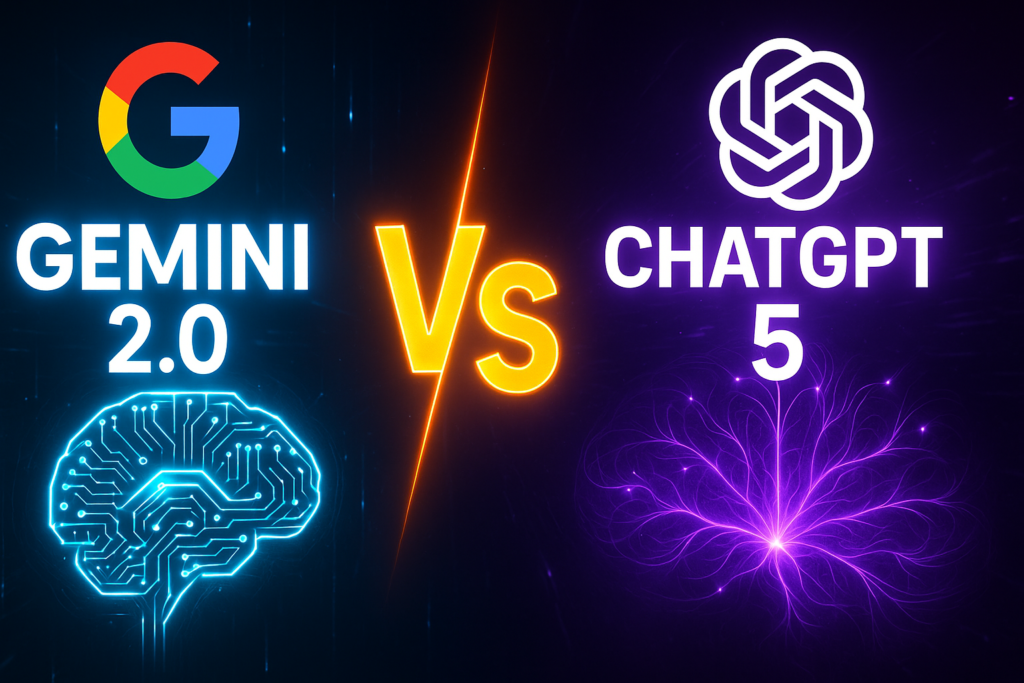
Artificial intelligence is moving faster than our morning coffee kicks in. In 2026, two names dominate every discussion: Google Gemini 2.0 and OpenAI’s ChatGPT 5.
What are Gemini 2.0 and ChatGPT 5?
Gemini 2.0 (Google)
Google introduced Gemini 2.0 as the next generation of its multimodal AI models. It was built to excel in text, image, audio, video, and code understanding. According to Google, the focus is on:
1. Advanced multimodality
2. Long-context understanding
3. Tight integration with Google Search and Workspace
4. Improved reasoning and factual grounding
ChatGPT 5 (OpenAI)
OpenAI positions ChatGPT 5 as a major upgrade focused on:
1. Better reasoning
2. Higher accuracy
3. Safer outputs
4. Improved autonomy (via ChatGPT and GPT APIs)
5. More reliable real-world task execution
Both companies have confirmed improvements—but neither has released traditional performance benchmarks. So this comparison is based on real-world user behavior, official statements, and the strengths seen in daily use.
Design Philosophy: How Each AI Thinks (Yes… AIs Have “Philosophies”)
Google’s Approach: Multimodal First
Google has been clear: Gemini 2.0’s architecture is designed around multimodality from the start. Instead of simply adding images or audio later, the model was built to understand them deeply.
Google claims:
1. Gemini 2.0 is optimized for mixed-input workflows.
2. It’s built to assist across YouTube, Gmail, Sheets, Drive, and Search.
3. Real-world grounding is stronger because of Google’s ecosystem.
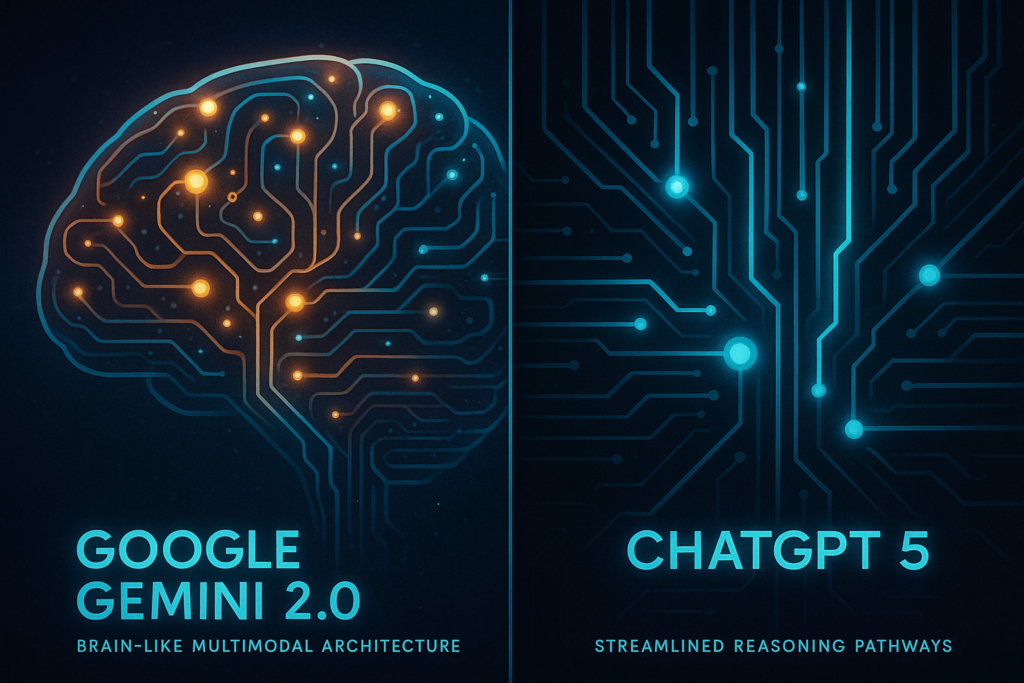
OpenAI’s Approach: Reasoning + Safety First
OpenAI highlights safety, reasoning, and reliability. ChatGPT 5 was trained to:
1. Reduce hallucinations
2. Improve step-by-step reasoning
3. Follow complex instructions
4. Produce consistent results across domains
OpenAI emphasizes that ChatGPT 5 should be a dependable “assistant” rather than a model that tries to understand every modality at once.
Real-World Performance: Where Each Model Excels
Text Understanding & Reasoning
Both models improved in this area, but their strengths differ.
Gemini 2.0
Users report strong performance in tasks requiring real-world context—for example:
1. Understanding maps
2. Analyzing documents
3. Combining visuals + text
4. Searching for information
Google’s integration with Search makes it particularly good at combining up-to-date knowledge with explanations.
ChatGPT 5
ChatGPT 5 shines at:
1. Logical reasoning
2. Multi-step task planning
3. Coding explanations
4. Research-based workflows
5. Writing, drafting, and editing
OpenAI markets ChatGPT 5 as more structured and coherent in complex reasoning tasks.
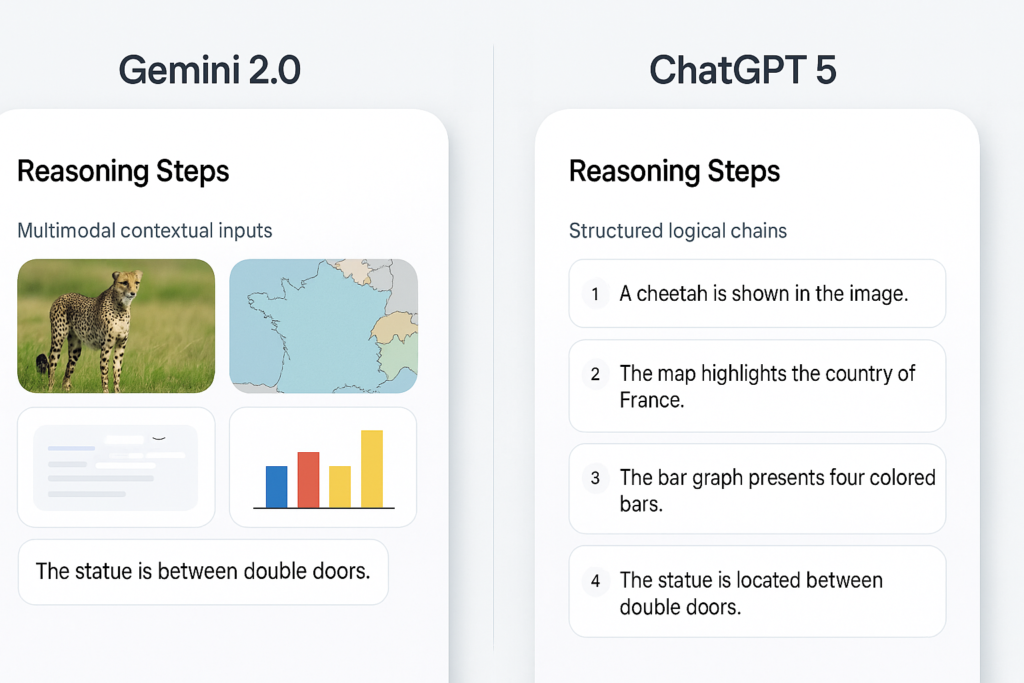
Multimodality (Images, Audio, Video)
Google has the advantage here.
Gemini 2.0
Google confirms Gemini 2.0 is built for deep multimodality across:
1. Images
2. PDFs
3. Audio
4. Video
5. Screenshots
It’s especially good at:
✔ Understanding visuals in detail
✔ Extracting text from complex images
✔ Mixing audio + visual + text inputs
✔ Identifying scenes, objects, and context
ChatGPT 5
OpenAI supports multimodal input (image + voice), but the system is still primarily optimized for text-first workflows. The visual understanding is solid but not as extensively integrated across Google’s ecosystem.

Coding & Developers
Gemini 2.0 for Developers
Google integrates Gemini 2.0 into:
1. Android Studio
2. Google Cloud
3. Colab
4. Vertex AI
This makes it convenient for developers working inside Google’s environment.
ChatGPT 5 for Developers
OpenAI focuses on:
1. Code interpretation
2. Cleaner explanations
3. More reliable debugging
4. Better API tools
5. Stronger reasoning frameworks for development
ChatGPT 5 tends to produce more consistent coding explanations in real-world use.
Integration & Ecosystem
Gemini 2.0 Strengths
Google’s strength lies in its ecosystem:
1. Search
2. Gmail
3. YouTube
4. Docs
5. Sheets
6. Drive
7. Android
Gemini 2.0 can analyze your files, summarize Gmail threads, and even help organize your Drive.
ChatGPT 5 Strengths
OpenAI focuses on:
1. ChatGPT app
2. OpenAI API
3. Third-party integrations
4. AI agents
5. Tool usage (actions + autonomy)
ChatGPT 5 is ideal for standalone or enterprise workflows where direct integrations are less important.
Safety & Reliability
Google’s Focus
Google emphasizes verifiable information and grounding responses in Search-provided data. This reduces hallucinations when asking fact-based questions.
OpenAI’s Focus
OpenAI focuses on:
1. More consistent reasoning
2. Avoiding unsupported claims
3. Structured safety systems
ChatGPT 5 aims to respond reliably, especially in professional or educational workflows.
Which One Should You Use?
Choose Gemini 2.0 if you want:
✔ Multimodal power
✔ Strong Google ecosystem integration
✔ Great visual comprehension
✔ Real-world contextual awareness
Choose ChatGPT 5 if you want:
✔ Deep reasoning
✔ Better writing and coding tools
✔ High reliability
✔ Strong autonomy with AI agents
There’s no absolute winner—just the better fit for your workflow.
Final Verdict
Both Gemini 2.0 and ChatGPT 5 are powerful upgrades built around different strengths.
Gemini 2.0 leads in multimodality and ecosystem integration, while ChatGPT 5 leads in reasoning, writing, and coding consistency.
The right choice depends on what you value most—not which AI wins imaginary benchmarks.